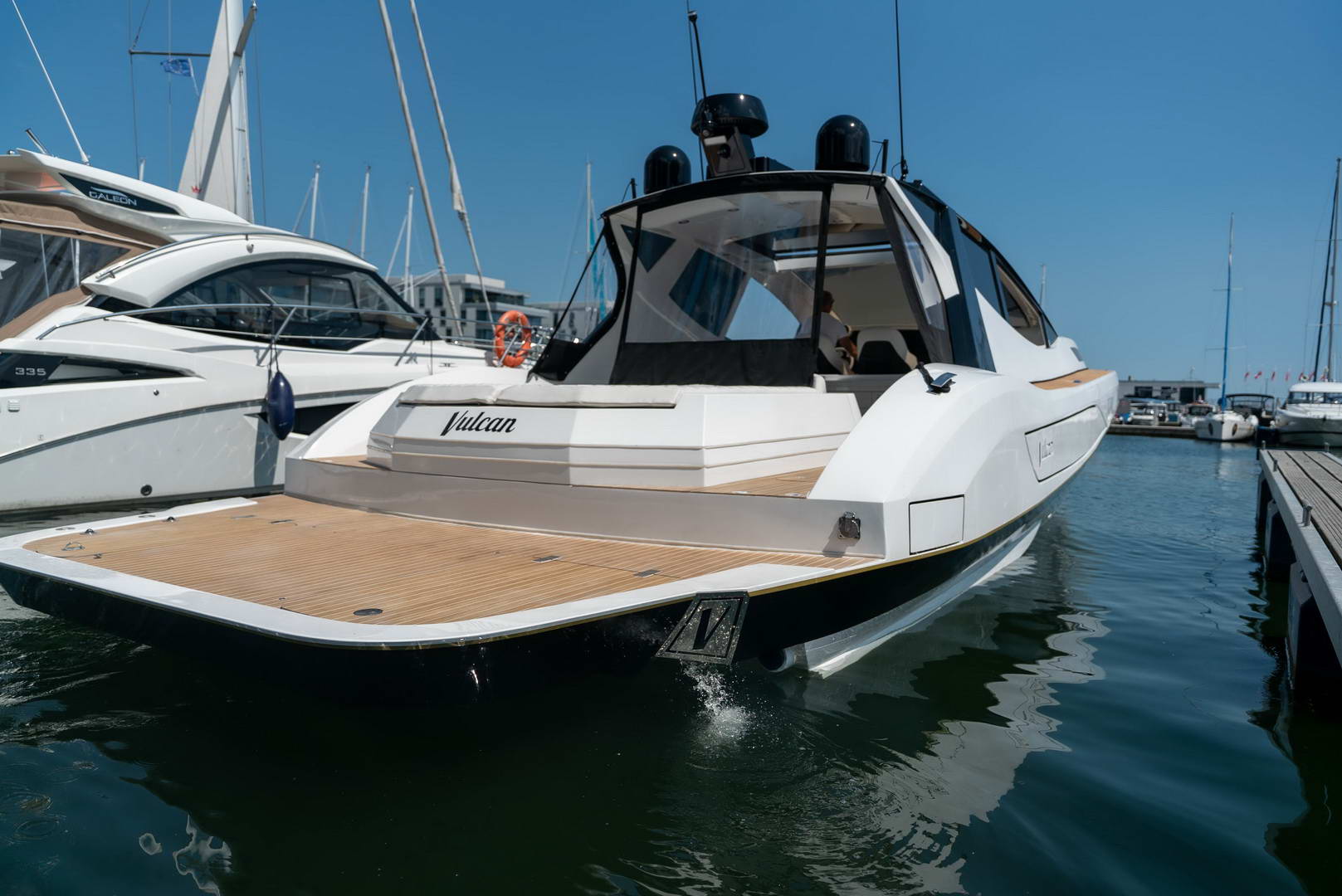
Ranked among the most elite cabin motor yachts, Vulcan is made with uncompromising attention to quality. Exceptional engine power, combined with a refined exterior profile and a wide range of advanced functionalities, delivers an unforgettable on-water experience.
The meticulously designed interior offers an exclusive atmosphere, achieved through the use of contemporary furnishings, premium textiles, and fully energy-efficient lighting solutions.
The highly efficient, stepped hull design reduces hydrodynamic resistance by approximately 15% compared to conventional hull forms. In operational mode, the propulsion system generates virtually no drag, as-apart from the propeller-there are no submerged components. The surface-piercing propellers provide outstanding efficiency of up to 70%, significantly exceeding the standard estimated range of 50–60%.
Specifications
Technical parameters of the powerboat yacht
Upon stepping aboard, you will experience exceptional comfort, intuitive handling, and unrestricted usability – including full accessibility for guests with disabilities.
Interior elements are electrically adjustable, allowing the space to be configured to individual preferences while creating environments that are accessible to everyone. The low aft bathing platform ensures effortless boarding and provides comfortable, safe access to the water for all users.
Basic parameters
Length overall (LOA) 14,5m
Water line (LWL) 12,0m
Beam overall (BOA) 4,2m
Draft 0,84m
Max height (without anchor light and with folded antennas ) 4,0m
Displacement light 12,3t
Displacement max 13,6t
Max persons on board 10
Class B
Top speed +38 kn
Cruising speed +32 kn
Electric 230V AC, 12V DC, 24 V DC, 5 V DC
Generator 2,8 kW
Tanks - Fuel 2x390 L
Tanks - Fresh water 330 L
Tanks - B&G water 110 L
Propulsion system
Speed and safety
The yacht is equipped with 390-liter fuel tanks featuring a fuel transfer system and ultrasonic level sensors, fully integrated with the onboard management system based on the NMEA 2000 protocol.
The propulsion system consists of twin 570 HP engines, connected via a gearbox and cardan shaft to a surface-piercing, trim-adjustable drive (vertical trim ±7°, lateral adjustment ±20°). This configuration ensures optimal performance, efficiency, and precise control in varying sea conditions.
Depending on sea state and load, the vessel’s maximum speed ranges between 35 and 38 knots.
Auxiliary systems include a bow thruster for enhanced maneuverability, as well as a electrically retractable anchor hatch with windlass (19 m of chain plus 70 m of rope), all fully controlled through the onboard management system.
A Luxury Motor Yacht
with character
Raw performance, refined comfort. Energy meets elegance. Speed without sacrificing safety. All on your terms. No compromises – this is your journey, your signature style.
Safety systems
Bilge system – equipped with three high-performance pumps operating in forced, manual, and automatic modes, monitored via the onboard management system. Two additional manual pumps are installed: one with a selector valve serving the cabin and technical compartment, and a second dedicated to the engine room.
Seafire fire protection system – based on temperature sensors, automatically shutting down engines, ventilation fans, and fuel valves at the tanks. Two independent fire extinguishers are installed: one in the engine room and one in the technical compartment, each activated independently via thermal ampoules.
C-POD system – a remote alarm and monitoring system providing mobile application notifications regarding vessel position, voltage drops, breach of security loops controlling access to the yacht, and activation of water sensors.
CO detection system – based on two independent carbon monoxide sensors with audible alarms, located in the engine room and the technical compartment.
Remote access system – operated via a four-channel remote control with programmed sequences, enabling activation of key functions (power supply, automatic window closing, ambient lighting).
Internet cameras – featuring recording capability, motion detection, and temperature monitoring, with programmable surveillance zones.
Hull
A defining feature of the yacht, beyond its exceptional design, is the combination of a stepped hull with a surface-piercing propulsion system.
This innovation emerged during the design process, driven by the goal of creating a fast yacht that stands out from the competition through maximum speed and travel comfort, while employing premium-grade finishing materials. Achieving these objectives required a careful balance. Drawing on the designers’ expertise and advanced CFD simulations, the team opted for this unique hull-propulsion combination.
Another element that provides a competitive edge is the advanced onboard management system, built on modern network protocols and EmpirBus modules, ensuring seamless control and operational efficiency throughout the yacht.
Fuel efficiency
Reducing Environmental Impact
The implementation of advanced, modern solutions in the new Vulcan yacht delivers significant ecological benefits, effectively reducing fuel consumption during operation.
This is achieved through a combination of features:
Highly efficient hull design, reducing hydrodynamic resistance by approximately 15% compared to conventional hull forms for vessels of this type.
Propulsion system generating virtually no drag in operational mode, with no submerged components beyond the propeller.
Surface-piercing propellers with exceptional efficiency – up to 70%, compared to the standard 50–60%.
The integration of these solutions results in a direct reduction of fuel consumption by approximately 20% compared to comparable vessels, delivering both performance and eco-conscious operation.